
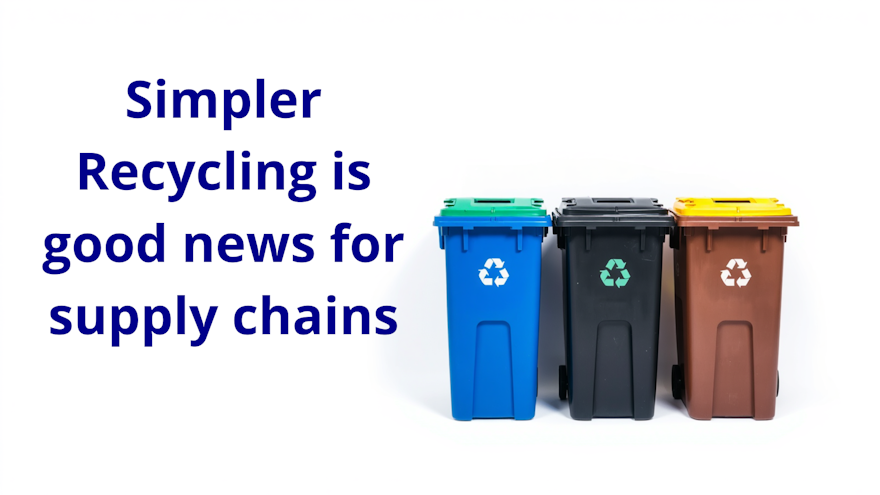
For years, England's recycling landscape has been characterised by inconsistency. Households in different local authority areas faced different rules, different bin configurations, and different levels of service. It was a postcode lottery that frustrated consumers, confused brands, and undermined the economic case for investing in recycling infrastructure.
The Simpler Recycling reforms were designed to fix this. And according to Steve Cole, Managing Director of Biffa Municipal, writing for letsrecycle.com, they're beginning to do exactly that.
What Simpler Recycling actually changes
The reforms introduce standardised recycling collection across England, establishing a consistent set of materials that all local authorities must collect. For households, this means less confusion about what goes where. For brands and packaging designers, it means a more predictable end-of-life pathway for their materials.
For the recycling industry itself, standardisation means higher-quality, more consistent material streams, which in turn makes it easier to process materials efficiently, reduces contamination, and strengthens the economic case for recycling infrastructure investment.
Steve Cole's piece in letsrecycle.com makes a compelling case that this standardisation is already starting to deliver tangible results, and that the success of the reforms depends on two things: strong partnerships across the supply chain, and a collective commitment to ending the postcode lottery of waste management once and for all.
Why this matters beyond the bin
It would be easy to view Simpler Recycling as a household issue, a change to what colour bin people use on a Tuesday morning, but its implications for the wider circular economy are significant.
When end-of-life processes are simplified and made consistent, the signal that travels back up the supply chain becomes clearer. Brands designing packaging for recyclability need confidence that the systems exist to actually recycle it. Without that confidence, the business case for investing in more recyclable packaging design weakens.
Simpler Recycling, alongside EPR's recyclability-based fee modulation and the Recyclability Assessment Methodology (RAM), is creating a much clearer set of incentives and infrastructure signals than the UK packaging industry has had before. The direction of travel is increasingly legible and that legibility is valuable.
Reath and Biffa: building the data layer
We're proud to partner with Biffa. It's inspiring to see their leadership on this issue and particularly their emphasis on how clarity in regulation, combined with operational excellence, can unlock the next phase of the circular economy.
As Steve notes, making recycling 'easier and more consistent' is the vital first step in ensuring no resource is lost to the system. At Reath, our role in that system is to provide the data infrastructure that sits alongside and supports it, helping brands understand what their packaging is, what it's made of, and how it performs against the recyclability standards that now have real financial consequences.
When the end-of-life process is simplified, the data challenge doesn't disappear. If anything, it becomes more important. Brands need to demonstrate that their packaging is genuinely recyclable under the new standardised system, not just theoretically recyclable under optimistic assumptions.
The momentum is real
The UK's journey toward a fully circular economy is complex and long-term. But the combination of Simpler Recycling, EPR, RAM, and the Deposit Return Scheme represents a coherent policy architecture that didn't exist five years ago.
The momentum from these reforms is undeniable. And the brands that are investing now in the data infrastructure to navigate that system rather than waiting to react to it will be the ones best placed to benefit.
Reath helps brands understand how their packaging performs within the UK's evolving recycling and compliance system. Find out more at reath.id